|
KU language departments taking a backseat
By Sarwat Ghulam Rasool
KARACHI: The need to learn new languages and their role in guaranteeing economic success has not diminished. Keeping this is mind, many scholars and different universities of the world have been languages their due importance while the University of Karachi (KU) Languages’ Departments seems to be neglected, as they are in a shabby condition.
Owing to the sorry conditions of the departments, students also opt out of taking admission there and do not want to learn different languages.
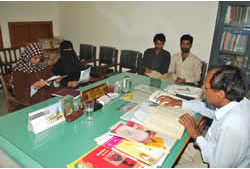
The languages departments include Bengali, Persian, Urdu, Arabic and Sindhi. What is surprising is that the entire Bengali department has only one professor while the strength of the students does not exceed four. The room originally assigned for this class is not even used for its actual purpose, as the class is usually held in the professor’s office.
The Persian and Arabic departments have, more or less, the same condition as the Bengali department. However, the Persian department has about six to seven students at an average while the number of students reduces as the years progress; there are only two students in the third year of the Persian department. The fate of the Sindhi department is somewhat better but the department itself is in a deplorable condition.
Persian department Chairman Dr Prof Shahla Saleem Noori said, “Basically learning the Persian language is not encouraged by the government and the vacancies for teachers teaching Persian are never announced, hence the lack in teaching staff, while following the disinterest of the government even students shy away from the language.”
She went on to say that in Karachi there are about a 100 government girls’ colleges and Persian is taught at only five of them while Persian is not taught at any of the government colleges for boys. The students who have not learnt Persian at college level do not show interest in the language at university level either.
Samra Zaheer, a student of the Persian department, said, “Only those students who do not have high percentages and are not eligible for other departments opt for languages. However, they also enter the university, wait for an year or two and then change departments.”
Bengali department Chairperson and Prof Dr Abu Tayyub Khan said that the Bengali department is one of the oldest departments of KU and it was established in 1953. When the department was initially started, it was considered to be important but since Bengal separated from Pakistan, it is being neglected.
Hina Iqbal, who is studying in the Bengali department, said that she was interested in learning different languages and after she learns to speak Bengali she will probably change departments.
Urdu department’s student Uzma Sikander said, “Most students in my department belong to the northern areas and it is has been seen that many students of the Urdu department are hesitant in admitting that they belong to the department.” She went on to say Urdu is not our government’s language and most of the students understand that getting a good job after completing masters in Urdu is very difficult.
Sindhi department chairperson Prof Dr Khursheed Abbasi said, “Students understand that if they choose Sindhi as their major subject it will cause them problems in getting jobs but after the introduction of several Sindhi channels and newspapers the strength of students opting the language are increasing.”
However, KU Faculty of Arts Dean Dr M Shamsuddin who supervises the language departments said, “They are working to up grade the departments and will offer certificate programmes to support them.” He added that the Iranian Culture Centre has been established to encourage students to learn the Persian language and a research programme in Bengali will start from next year.
“In our country, education is not given top priority as only 1.7 of the Gross Domestic Product is spent on education, this in turn makes it difficult to promote all fields of education,” said KU Registrar Prof M Raees Alvi. He added that every language is important in its own way but less and less importance is being given to learning other languages while in many developed countries, the promotion of different languages is very common. This not only increases understanding of different cultures but also give an edge in the job market.
The News:
|
